
Understanding persistent scar pain, tightness and sensitivity – and what you can do about it.
Your surgery may have been five, ten or even twenty years ago. The wound healed, the stitches came out, and life carried on.
But perhaps the scar has never quite felt right.
You may notice numbness, tingling or an unusual sensitivity to clothing. Sometimes, the skin around the scar feels as though it is stuck to the tissues underneath.
It might pull when you stretch, feel tender when touched, or become uncomfortable during certain movements.
You may even have been reassured that everything has healed normally, leaving you wondering why you’re still experiencing discomfort.
The short answer is that a surgical scar can remain uncomfortable long after the skin has healed.
Changes in tissue mobility, nerve sensitivity and other effects of surgery can all contribute. However, pain around a scar isn’t necessarily caused by the scar itself.
The good news is that there may be ways to better understand and manage your symptoms, even many years after surgery.
In this article, we’ll explore why old surgical scars sometimes hurt, what treatment options are available and when it may be appropriate to seek professional help.
What happens to scar tissue after surgery?
When you undergo surgery, your body begins repairing the tissues affected by the operation.
As part of this natural healing process, your body produces collagen to help repair the wound. The resulting scar tissue is essential for healing, but it differs from the original tissue.
Initially, a scar may appear red or raised and feel firm, sensitive or uncomfortable. Over time, many scars become flatter, softer and less noticeable.
According to the NHS, scars can continue changing for two years or more.
However, every scar heals differently.
Some remain sensitive or firm. Others may feel tight during certain movements. Depending on the surgery, there may also be changes to nearby nerves, muscles and other tissues.
It’s important to remember that a scar’s appearance doesn’t always reflect how it feels.
A scar may look completely healed while the person continues to experience discomfort. Equally, a large or noticeable scar may cause no problems at all.
Five possible reasons your surgical scar still hurts
There is no single explanation for persistent scar pain. Understanding the possible causes is important because different problems may require different approaches.
1. Changes in how the scar and surrounding tissues move
Scar tissue has different properties from the original skin.
Sometimes the area around a healed incision feels less flexible than the surrounding tissue, which may contribute to sensations of tightness or pulling.
You might notice:
- Discomfort when stretching or bending.
- Tightness around an abdominal incision.
- Pulling during particular movements.
- A feeling that the skin doesn’t move as freely as it used to.
For example, following abdominal surgery, someone may notice a pulling sensation when standing upright or twisting.
After knee surgery, the incision area may feel uncomfortable when bending the knee.
However, this doesn’t automatically mean there are deep internal adhesions or that the scar is responsible for all movement restrictions.
A thorough assessment should consider the scar alongside the surrounding muscles, joints, nerves and other tissues.
2. Changes to the nerves around the scar
Surgical incisions can affect small sensory nerves in the skin and surrounding tissues.
As a result, some people experience changes in sensation that persist after the wound has healed.
These may include:
- Numbness or reduced sensation.
- Tingling or pins and needles.
- Burning or shooting pain.
- Sensitivity to touch or pressure.
- Discomfort when clothing brushes against the scar.
For some people, these changes improve gradually. For others, they can be long-lasting.
Occasionally, persistent pain may be associated with nerve irritation or a painful neuroma, which can develop following nerve injury.
If you experience persistent burning or electric-shock sensations, or new or worsening numbness, medical assessment is advisable.
Scar therapy cannot guarantee the restoration of normal nerve function.
3. Stiffness or changes in movement following surgery
After an operation, it’s natural to protect the affected area while it heals.
You may temporarily avoid certain movements, lose some strength or become less confident using that part of your body.
Sometimes these changes continue long after the initial recovery period.
For example:
- Following knee replacement surgery, joint stiffness or muscle weakness may contribute to discomfort.
- After abdominal surgery, certain movements may feel tight or unfamiliar.
- Following shoulder surgery, reduced mobility may affect how the tissues around the incision feel.
Although scar tissue may contribute to some symptoms, it isn’t always the main problem.
In these circumstances, physiotherapy or a structured rehabilitation programme may be more appropriate than scar-focused treatment alone.
4. Persistent sensitivity around the scar
Perhaps clothing rubbing against it is irritating, or a light touch produces a stronger sensation than you would expect.
Does your scar feel uncomfortable when touched, even gently?
This can happen when the nerves and sensory pathways around an area have changed following injury or surgery.
Some people experience heightened sensitivity to sensations that would not normally be painful.
Depending on the cause, carefully graded exposure to touch and different textures may sometimes form part of a sensitivity-management programme.
However, this should be introduced gradually and adapted to the individual.
Scar treatment should not involve forcing painful pressure onto sensitive tissues.
5. The pain may not be coming from the scar itself
This is an important consideration.
Just because pain occurs close to a surgical scar doesn’t necessarily mean the scar is causing it.
Discomfort may be related to:
- A nearby joint or muscle.
- Nerve irritation or damage.
- Ongoing effects of the original operation.
- Another musculoskeletal condition.
- A separate medical problem requiring investigation.
For example, persistent pain following a knee replacement shouldn’t automatically be attributed to scar tightness.
Similarly, abdominal pain after surgery may have causes unrelated to the external scar.
This is why a suitable assessment is so important.
Rather than assuming scar tissue needs to be treated, the first priority should be understanding why you’re experiencing symptoms.
Can an old surgical scar still improve after ten or twenty years?
This is a common concern among people who have lived with scar discomfort for a long time.
You may have assumed that, because the surgery happened years ago, nothing further can be done.
However, the age of a scar doesn’t automatically determine whether assessment or treatment might be helpful.
Even with an older scar, there may be opportunities to improve comfort or manage certain symptoms.
Depending on your circumstances, this could involve:
- Identifying possible contributors to pain or sensitivity.
- Exploring how the scar and surrounding tissues move.
- Learning appropriate self-care techniques.
- Improving confidence with movement or touch.
- Addressing relevant muscle or joint restrictions.
- Considering specialist scar therapy where appropriate.
It’s important, however, to have realistic expectations.
Scar therapy cannot erase a surgical scar, guarantee the restoration of sensation or reliably break down deep internal adhesions.
Some people experience improvements in comfort or movement, while others notice little change.
The key is establishing what may be contributing to your symptoms and whether a particular treatment is likely to be suitable.
Which types of surgical scars can cause long-term discomfort?
Persistent discomfort can occur following many different operations.
At Advance SRM Therapies, we see people with concerns relating to several types of surgical scars.
Abdominal and gynaecological surgery
Scars following C-sections, hysterectomies, hernia repairs, appendectomies and other abdominal procedures may be associated with local tightness, sensitivity or discomfort during movement.
Some people notice pulling when stretching or changing position, while others are more concerned about altered sensation.
Orthopaedic surgery
Operations such as knee replacements, hip replacements, ACL reconstructions and other joint procedures can leave scars in areas involved in everyday movement.
It’s important to distinguish discomfort around the incision from symptoms involving the joint, muscles or nerves.
Breast and chest surgery
After breast surgery, mastectomy or other chest procedures, some people experience ongoing sensitivity, altered sensation or discomfort around the healed incision.
These symptoms should be considered in the context of the person’s wider surgical and medical history.
Keyhole surgery
Even small incisions can sometimes remain sensitive or uncomfortable.
A scar doesn’t have to be large or particularly noticeable to cause concern.
Trauma and injury-related scars
Scars resulting from accidents, burns, skin grafts or injuries may also be associated with longer-term sensitivity or movement concerns.
Each person’s experience is different. The type of surgery, healing process, underlying conditions and current symptoms all influence what support may be appropriate.
What treatments might help an old, painful surgical scar?
There isn’t one treatment that works for everyone.
The most suitable approach depends on your symptoms, their underlying cause and your personal goals.
Gentle self-care and scar massage
For some fully healed scars, gentle massage, moisturising or other self-care techniques may be appropriate.
The NHS provides general guidance on scar care, including massage once a wound has fully healed.
However, massage isn’t suitable for every situation and shouldn’t be used on broken, inflamed or infected skin.
If self-massage causes significant pain, irritation or worsening symptoms, stop and seek professional advice.
Physiotherapy and rehabilitation
If your main difficulty involves joint movement, weakness, stiffness or returning to everyday activities, physiotherapy may be particularly helpful.
For example, someone recovering from knee or hip surgery may benefit from rehabilitation that addresses joint mobility, strength and movement.
Scar-focused treatment may sometimes complement this approach, but shouldn’t replace necessary rehabilitation.
Medical assessment or specialist care
Some painful scars require further medical investigation.
Depending on the symptoms, your GP or surgical team may consider referral to a dermatologist, plastic surgeon, pain specialist or another relevant professional.
This is particularly important if pain is new, worsening or associated with other unexplained symptoms.
Specialist external scar therapy
Scar therapy may be another option for certain fully healed scars.
At Advance SRM Therapies in Clanfield, Hampshire, we take an individual approach to assessing scar-related concerns.
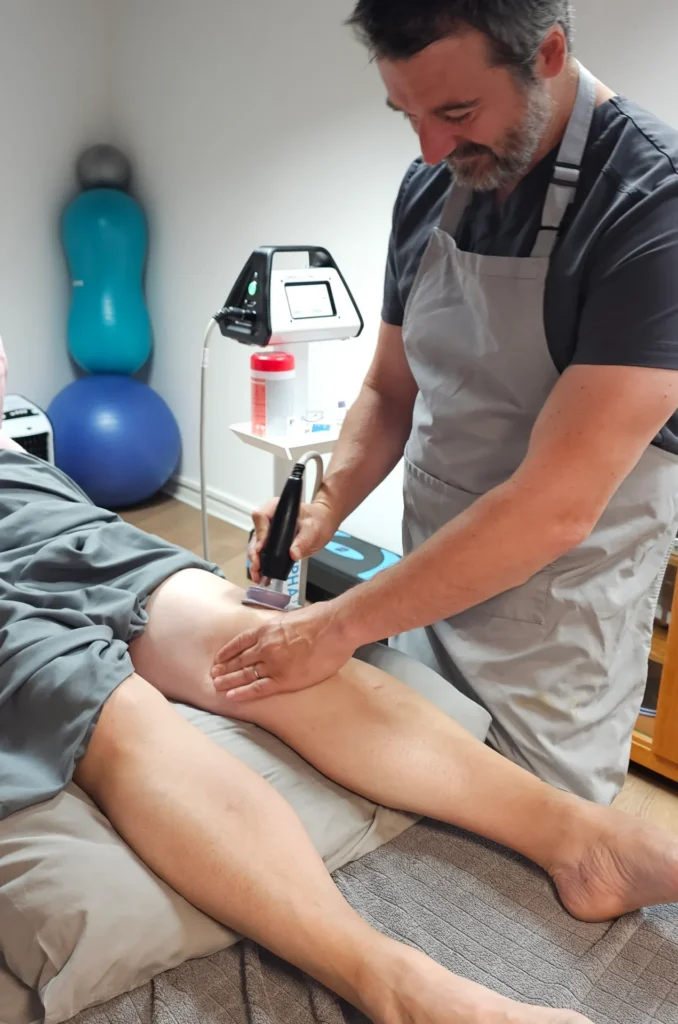
Our external, non-invasive scar therapy may involve gentle hands-on techniques, movement or sensory guidance, and equipment such as LymphaTouch where clinically appropriate.
The aim is to explore whether suitable treatment may help with comfort, sensitivity or local tissue mobility.
However, the research supporting different manual scar therapy techniques varies, and improvement cannot be guaranteed.
We also recognise when another healthcare professional may be better placed to help.
Learn more about Scar Tissue Therapy at Advance SRM
Can scar therapy make an old scar worse?
This is an understandable concern, particularly if the area is already painful or sensitive.
Scar therapy isn’t automatically appropriate for everyone.
Applying excessive pressure or using unsuitable techniques may aggravate symptoms rather than relieve them.
For this reason, treatment should always take account of your medical history, scar condition, current symptoms and personal comfort.
At Advance SRM, our approach is gentle and individualised.
We discuss what we’re doing, explain the available options and make sure you remain comfortable with the assessment and treatment.
You can ask for any technique to be changed or stopped.
Sometimes the most appropriate recommendation is to delay hands-on treatment or seek additional medical advice.
When should you seek medical advice about scar pain?
Although some scar-related discomfort can persist, certain symptoms shouldn’t be ignored.
Contact your GP, surgical team or NHS 111 promptly if you experience:
- Increasing pain, redness, heat or swelling around the scar.
- Discharge or changes suggesting infection.
- A wound that breaks down or reopens.
- Fever or feeling increasingly unwell.
- A new lump, unexplained swelling or significant changes in the area.
- New or worsening numbness, weakness or other neurological symptoms.
Severe symptoms, including sudden breathlessness, chest pain or serious neurological changes, may require emergency medical care.
If you’ve had persistent scar pain that hasn’t previously been investigated, it’s sensible to seek medical advice before assuming the scar is responsible.
Scar therapy is not a substitute for medical diagnosis or treatment.
What happens during a scar therapy assessment at Advance SRM?
If your scar is fully healed and you’re considering professional support, the first step is understanding your individual circumstances.
At Advance SRM, we begin with a conversation about your surgical history, symptoms and what you hope to achieve.
We may explore questions such as:
- What type of surgery did you have?
- How long ago was the operation?
- How did the wound heal?
- What sensations or movements cause discomfort?
- Have your symptoms changed over time?
- What treatments or self-care approaches have you already tried?
- What would you most like to improve?
Where appropriate and with your consent, we may assess the scar and surrounding tissues.
We’ll discuss any suitable treatment options, explain their limitations and consider whether another professional may need to be involved.
You remain in control throughout the appointment.
There is no expectation that everyone needs a course of treatment, and any recommendations should reflect your individual circumstances.
Frequently asked questions about old surgical scars
Is it normal for a scar to hurt ten years after surgery?
Pain or sensitivity can persist for years after surgery, but this doesn’t mean it should automatically be considered normal or ignored. The cause may involve nerves, surrounding tissues or another medical condition. An assessment can help determine what might be contributing.
Can scar tissue cause pain years after surgery?
Changes in scar tissue and surrounding sensation may contribute to discomfort. However, pain occurring near a scar doesn’t prove that the scar itself is responsible.
Can scar massage break down old scar tissue?
Massage cannot remove a scar or reliably break down deep internal adhesions. Some people may find gentle techniques helpful for managing discomfort or improving local tissue mobility, but results vary.
Is it too late to have scar therapy after twenty years?
Not necessarily. Older scars can still be assessed, and some people may benefit from appropriate treatment or self-management advice. The likely benefit depends on the cause of the symptoms rather than the scar’s age alone.
How many scar therapy sessions will I need?
There is no fixed number. Your symptoms, treatment goals and response to care all influence whether further sessions are appropriate. An initial assessment can help establish a sensible plan.
Should I see a scar therapist or a physiotherapist?
If the main concern is reduced strength, joint stiffness or difficulty with movement, physiotherapy may be an important option. If you have specific concerns about a fully healed scar, a suitably trained scar therapist may be able to assess them. In some situations, both approaches can complement one another.
Final thoughts: Understanding your scar is the first step
Living with discomfort around an old surgical scar can be frustrating, particularly when the wound has appeared healed for years.
You may have become used to avoiding certain movements or assumed that sensitivity and tightness are simply things you have to live with.
But persistent symptoms deserve to be understood.
For some people, simple self-care or rehabilitation advice may be enough. Others may benefit from further medical investigation or specialist scar assessment.
At Advance SRM Therapies, we believe in taking time to understand your individual situation and helping you make informed decisions about your care.
If your scar is fully healed but you’re still experiencing discomfort, tightness or sensitivity, you can explore whether our scar therapy service may be suitable for you.
Explore Scar Tissue Therapy at Advance SRM
This article provides general information and is not a substitute for personalised medical advice. Persistent, unexplained or worsening symptoms should be assessed by an appropriate healthcare professional.