
Understanding scar adhesions, myofascial restrictions and the pulling sensations that can remain long after a Caesarean birth.
Your C-section may have been a few months ago, several years ago or even longer.
The wound has healed, and life has moved on. But perhaps the scar has never quite felt right.
You might notice pulling when you stand upright or stretch, tightness across your lower abdomen, or a feeling that the skin around your scar is stuck to something underneath.
Perhaps the area feels hard, restricted or uncomfortable when you move. You might also have a patch of numbness, sensitivity to touch or a small fold of tissue above the incision.
These symptoms can be frustrating, particularly when you’ve been told that your scar has healed well.
So why does your C-section scar still feel tight, numb or painful?
One possible explanation is that healing has changed how the layers of tissue around your incision move against one another. Scar-related myofascial restrictions or adhesions may contribute to tightness, tethering and pulling sensations, even after the skin has fully healed.
Changes in sensory nerves, abdominal muscle function and other postoperative conditions may also contribute.
At Advance SRM Therapies, understanding how the scar and surrounding soft tissues move is an important part of assessing these concerns.
In this article, we’ll look at what happens beneath a C-section scar, how scar adhesions can affect movement, what myofascial treatment aims to achieve and when another form of medical care may be necessary.
What happens beneath the skin during a C-section?
A Caesarean section involves more than making an incision through the skin.
To deliver your baby, the surgeon needs to pass through several layers of the abdominal wall before reaching the uterus.
These include:
- Skin: The visible surface where the external scar forms.
- Subcutaneous tissue: The fatty and connective tissue immediately beneath the skin.
- Fascial layers: Sheets of connective tissue that surround and support structures within the abdominal wall.
- Abdominal muscles: These are generally separated or moved aside during the procedure.
- Deeper abdominal tissues: Including the peritoneal layers and the uterus, which has its own surgical incision.
During healing, the body produces collagen to repair the tissues affected by surgery.
This is a normal and essential process.
However, the organisation and movement of the repaired tissues may differ from the original tissues.
For some people, healing is relatively straightforward and the scar causes few difficulties.
For others, the tissues around the incision may feel less mobile, firmer or more sensitive.
This is where the relationship between scar tissue, fascia and movement becomes particularly relevant.
What is fascia, and why does it matter after a C-section?
Fascia is connective tissue found throughout the body.
It surrounds, connects and supports muscles and other structures, helping tissues work together during movement.
Around your abdomen, several connective tissue layers contribute to the way your skin, muscles and abdominal wall move.
When you bend, stretch, twist or reach, these tissues need to accommodate the movement.
One way to think about this is to imagine several layers of fabric moving across one another.
When those layers move comfortably, the movement may feel unrestricted.
But if an area becomes less mobile, movement can create a pulling or tethering sensation.
Following surgery, healing and scar formation can change the mechanical properties of the tissues around the incision.
Some areas may feel firmer or less able to glide than the surrounding tissue.
This is often described clinically as a myofascial restriction or reduced tissue glide.
Importantly, it doesn’t mean the fascia is damaged or dysfunctional simply because a scar exists. What matters is whether the change in movement appears to be contributing to symptoms.
What are scar adhesions after a C-section?
The word adhesion describes tissues becoming connected or attached in a way that can restrict their independent movement.
After surgery, scar-related connections may develop between tissue layers as part of the healing process.
Around an external C-section incision, this may contribute to areas of reduced mobility between the skin, subcutaneous tissue and underlying abdominal-wall structures.
You may notice:
- A feeling that the scar is stuck or tethered.
- Pulling when stretching or standing upright.
- Reduced movement of the skin around the scar.
- Localised tightness or discomfort.
- A firm area around part of the incision.
- Sensitivity when the tissues are moved or stretched.
NHS postnatal physiotherapy guidance recognises that the tissues around a Caesarean scar can become attached to underlying layers, contributing to sensations of tightness and discomfort.
However, not every firm or uncomfortable scar contains a clinically significant adhesion, and the sensation of pulling doesn’t prove that an adhesion is present.
An assessment can explore superficial scar mobility and associated symptoms, but hands-on examination alone cannot confirm the presence or extent of deeper internal adhesions.
Are myofascial restrictions the same as internal abdominal adhesions?
Not exactly, and understanding the difference is important.
Abdominal-wall restrictions involve the movement of the external scar and surrounding soft tissues, including the fascia and tissues accessible through external assessment.
These are the areas that scar-focused manual therapy may attempt to influence.
Intra-abdominal adhesions, by contrast, are bands of scar tissue that can form between internal organs or deeper abdominal structures following surgery.
They may be asymptomatic, but can sometimes contribute to abdominal or pelvic pain and, in certain cases, bowel obstruction.
These deeper adhesions cannot reliably be diagnosed by feeling the external scar, and there is insufficient evidence to claim that external massage physically breaks them apart.
At Advance SRM, the focus of our external scar therapy is on assessing and addressing appropriate scar-related restrictions and symptoms within the abdominal wall, rather than treating internal surgical complications.
Why does my C-section scar pull when I stretch or stand upright?
This is one of the most common questions people have about a healed C-section scar.
When you stand upright, extend your torso or reach overhead, your abdominal wall changes position and length.
The skin and connective tissues around your lower abdomen need to accommodate that movement.
If an area around the scar has reduced mobility, you may experience a sensation of pulling or tension.
For example, you might notice discomfort when:
- Standing fully upright after sitting.
- Stretching your arms overhead.
- Reaching backwards.
- Twisting your body.
- Returning to exercise.
- Performing movements that stretch the lower abdomen.
Some people describe the feeling as though the scar is holding them back.
Others say the skin feels tight, or that there is a band of tension across the lower abdomen.
Why does the scar sometimes feel stuck?
During assessment, some healed scars move readily with the surrounding skin.
Others may feel less mobile in particular directions.
The tissues above the scar might move relatively comfortably, while an area immediately around the incision feels more restricted.
This variation in movement can help a practitioner understand where local discomfort may be arising.
However, it is not a definitive test for deep adhesions.
Reduced mobility may reflect several factors, including collagen organisation, tissue stiffness, sensitivity and differences between the scar and surrounding tissue.
The important question is whether the findings relate meaningfully to your symptoms and movement.
Can scar adhesions affect the appearance of a C-section scar?
Some people notice a small fold or overhang of tissue above their C-section incision.
This is sometimes referred to as a C-section shelf.
Several factors may contribute to its appearance, including:
- Normal skin and fat distribution.
- Changes in abdominal tissues following pregnancy.
- Scar position and healing.
- Localised tethering or reduced tissue mobility.
- Individual body shape and tissue characteristics.
Where the scar is tethered, the tissues immediately around it may sit or move differently.
In some circumstances, improving the comfort or mobility of superficial tissues may change how the area feels or moves.
However, a C-section shelf is not always caused by adhesions, and manual scar therapy cannot be expected to remove excess skin or reliably change the appearance of the abdomen.
At Advance SRM, we place greater emphasis on comfort, mobility and function than on promising cosmetic changes.
Why is my C-section scar numb or unusually sensitive?
Tissue restrictions aren’t the only possible consequence of surgery.
During a C-section, small sensory nerves may be affected.
This can leave an area around the incision feeling numb, tingly, tender or unusually sensitive.
Some people notice a patch of reduced sensation above the scar.
Others find that light touch, pressure or clothing feels uncomfortable.
Scar-related tissue stiffness and altered sensation can occur together, but they are not necessarily caused by the same process.
A practitioner may therefore need to consider both the way the tissues move and how the area responds to touch.
Can myofascial scar therapy help with sensitivity?
Some people may benefit from gentle sensory work, graded touch or carefully selected external treatment.
For others, nerve-related symptoms may require medical assessment or a different approach.
The aim is to find strategies that improve comfort and tolerance, rather than assuming all sensitivity can be resolved by mobilising scar tissue.
Normal nerve sensation cannot be guaranteed to return.
Can myofascial scar therapy improve C-section adhesions?
This is particularly relevant to the work we do at Advance SRM.
For some fully healed scars, external manual therapy may be considered to address local soft tissue stiffness, reduced tissue glide and associated discomfort.
Treatment may involve applying carefully controlled movements to the skin and surrounding soft tissues.
These techniques are intended to influence how the external scar and abdominal-wall tissues move and tolerate movement.
Depending on the individual, treatment may focus on:
- Assessing scar mobility in different directions.
- Exploring areas of localised tissue restriction.
- Using gentle mobilisation of the surrounding tissues.
- Supporting comfortable movement through the lower abdomen.
- Addressing touch sensitivity where appropriate.
- Providing guidance for suitable self-care between appointments.
The aim is not to forcefully break apart scar tissue.
Instead, the focus is on appropriately graded treatment intended to improve comfort and movement where possible.
How does Advance SRM assess C-section scar restrictions?
At Advance SRM Therapies in Clanfield, Hampshire, we consider the scar as part of the wider picture.
Rather than looking only at how the incision appears, we want to understand how it feels, how the surrounding tissues move and what effect the symptoms have on your daily life.
An assessment may explore:
Your surgical history
When did you have your C-section? How did the wound heal? Were there any complications, infections or additional procedures?
Your symptoms
Do you experience pulling, tightness, numbness, sensitivity or discomfort? Are these symptoms constant or associated with particular movements?
Tissue mobility
Where clinically appropriate and with your consent, we may assess how the skin and surrounding soft tissues move around the fully healed scar.
Movement and function
Does stretching, standing upright, bending or another activity reproduce the sensation?
Other possible contributors
Could abdominal muscle function, pelvic health concerns, nerve sensitivity or another medical issue be relevant?
The goal is to decide whether external scar-focused treatment is appropriate and to identify when other professional support may be useful.
What techniques might be used to address myofascial restrictions?
When clinically suitable, scar therapy may involve gentle external mobilisation of the skin and surrounding soft tissues.
Different directions of movement may be explored to assess where tissue glide feels reduced or uncomfortable.
Treatment should be adapted to the individual and should not rely on painful, forceful pressure.
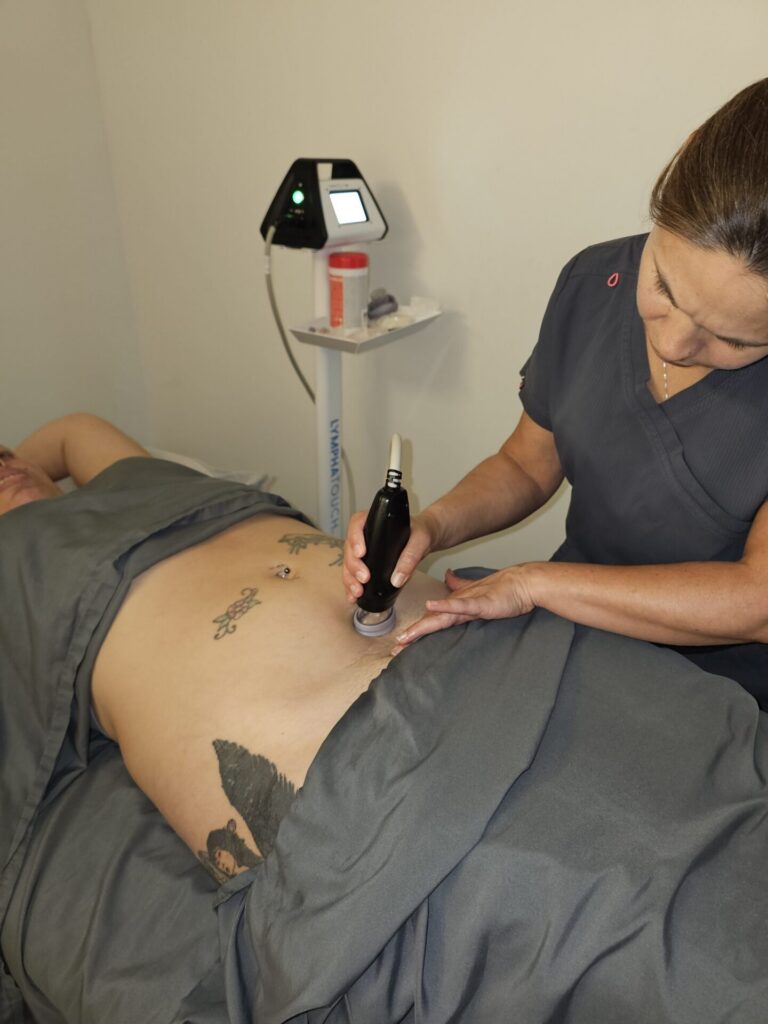
At Advance SRM, our scar therapy approach may also incorporate LymphaTouch when appropriate.
What is the role of LymphaTouch?
Lymphatouch is a non-invasive device that applies controlled negative pressure to the skin and underlying superficial tissues, to gently encourage lymphatic drainage and improve circulation around the area of the scar, as well as improve tissue mobility.
It may be used as part of an individual treatment approach where local tissue stiffness or reduced glide is a concern.
Learn more about C-section scar therapy at Advance SRM
Is it too late to treat myofascial restrictions years after a C-section?
No. The age of a scar alone does not mean that assessment or symptom-management strategies are no longer worthwhile.
Some people seek help many years after surgery because they have continued to notice pulling, sensitivity or local tightness.
Others only become aware of these sensations when they return to a particular exercise or activity.
Even with an older scar, it may be useful to assess local tissue mobility, movement and other contributing factors.
However, the potential benefit depends on the individual.
Longstanding restrictions may not respond as easily to treatment, and not every pulling sensation is caused by scar adhesions.
Can I massage my C-section scar myself?
For many people, appropriate self-care can be a useful part of recovery.
NHS physiotherapy guidance provides advice on gentle scar massage once the wound is fully healed.
The intention is to support comfort, sensitivity management and appropriate scar mobility.
However, timing matters.
Do not begin scar massage while the wound is open, infected, irritated or still healing.
If you have had complications, further abdominal surgery or specific postoperative restrictions, seek advice from your surgical or healthcare team first.
You should not attempt forceful deep abdominal massage to break up suspected internal adhesions.
If self-massage causes significant pain, worsening symptoms or concerns, stop and seek professional advice.
When is C-section scar therapy not appropriate?
External scar therapy is not always the right starting point.
It may need to be delayed or avoided if the wound has not healed sufficiently, there is infection, or there are other medical concerns.
Seek prompt medical advice if you develop:
- Increasing redness, heat or swelling around the scar.
- Pus, discharge or wound breakdown.
- Fever or feeling increasingly unwell.
- New or worsening abdominal pain.
- A new or painful lump around the incision.
- New or progressive neurological symptoms.
Severe abdominal pain with persistent vomiting, abdominal swelling or an inability to pass wind or stools may indicate bowel obstruction and requires urgent emergency assessment.
If you have bladder or bowel symptoms, pelvic floor concerns or difficulty returning to exercise, a pelvic health physiotherapist may also be an important part of your care.
Scar therapy should complement appropriate medical and rehabilitation support, not replace it.
Frequently asked questions about C-section adhesions and myofascial restrictions
Can C-section scar adhesions cause pulling sensations?
Reduced tissue mobility or scar-related tethering within the abdominal wall may contribute to pulling sensations, particularly during stretching or movement. However, pulling alone does not confirm adhesions, and other causes should be considered.
Can fascia become restricted after a C-section?
Surgery and healing can change the mechanical properties of the fascia and surrounding soft tissues. Some people experience reduced tissue glide or localised stiffness around the scar.
Can scar massage release adhesions after a C-section?
Gentle scar mobilisation may help some people with comfort and external tissue mobility.
Why does my C-section scar feel stuck to the tissue underneath?
Scar formation can change the way the skin and underlying superficial tissues move relative to one another.
Can myofascial scar therapy help a ten-year-old C-section scar?
An older scar may still be assessed, and some people may benefit from appropriate treatment or movement guidance. The response depends on the symptoms and underlying cause, not simply the scar’s age.
Is LymphaTouch necessary for treating C-section adhesions?
Not necessarily, although in many cases we find it very helpful. LymphaTouch may be considered for particular concerns around tissue mobility, but it is not essential for every person.
Should I see a scar therapist or pelvic health physiotherapist?
This depends on your symptoms. External scar-related sensitivity and restricted tissue glide may be suitable for a scar-focused assessment, while pelvic floor, bladder, bowel and broader postnatal rehabilitation concerns may require pelvic health physiotherapy. Sometimes both approaches can work alongside each other.
Final thoughts: It’s about more than the visible scar
A C-section scar may look fully healed while the surrounding tissues continue to feel tight, sensitive or restricted.
For some people, scar-related changes in the abdominal wall can contribute to pulling sensations and reduced comfort during movement.
Understanding the role of the fascia and how different tissue layers move helps explain why an external scar may still feel uncomfortable years after surgery.
At Advance SRM Therapies, our focus is on understanding how your scar and surrounding soft tissues are behaving, assessing whether external myofascial treatment is appropriate and helping you make informed decisions about your care.
We recognise that some people may benefit from scar-focused treatment, while others may need medical assessment, pelvic health physiotherapy or another form of rehabilitation.
If your C-section scar is fully healed but still feels tight, tethered, sensitive or uncomfortable, you can explore whether our approach may be suitable for you.
Explore Postnatal and C-Section Scar Therapy at Advance SRM
Learn More About LymphaTouch Therapy
This article provides general educational information and is not a substitute for medical assessment. Persistent, worsening or unexplained symptoms should be discussed with an appropriate healthcare professional.